The Modern Data Engineer Part 4A: Designing the Silver Semantic Boundary
The Silver-Gold boundary is where analytics platforms win or lose consistency. This part covers what the boundary is, why it fails, and how to design it explicitly with Conformed Entities.

The Modern Data Engineer Part 4A: Designing the Silver Semantic Boundary
In Part 3, I argued that normalized analytics models kill agility because they push too much interpretation into one supposedly universal structure. That problem shows up most clearly at the Silver-Gold boundary: teams can explain Bronze, point at Gold, and still leave the semantic contract in between undefined.
This part focuses on that boundary: where platforms decide whether shared meaning is materialized once or recreated in every dashboard. It is also where I introduce the pattern I use to make that boundary explicit: Conformed Entities.
1. The Gap Nobody Designs Explicitly
Most teams can explain Bronze ingestion. Most teams can point to Gold consumption outputs.
Ask what Silver is for, and answers get vague: cleaned source data, business-ready data, core entities, or some mix of all three. That ambiguity is not harmless. It means Silver is being asked to do two conflicting jobs at once: preserve source fidelity and encode business meaning.
Source fidelity demands neutrality. Business meaning demands explicit opinion.
When teams refuse to choose, ambiguity spreads from model design into metrics, dashboards, and decisions.
2. The Two Failure Modes
Most Silver implementations do not fail because teams are careless. They fail because teams try to make one layer do two incompatible jobs. The two patterns below look different in practice, but both push semantic debt downstream.
2.1 Silver as a polished landing zone
In this model, Silver is mostly technical hygiene:
deduplicated rows, normalized types, basic quality checks, and source-aligned structures.
Useful, but semantically thin.
Gold then carries most business logic. Every new KPI becomes Gold work. Gold models grow bloated and brittle. Analysts fork definitions in BI to move faster. You keep local flexibility but lose global consistency and platform speed.
2.2 Silver as “business-ready”
Here Silver starts absorbing domain rules while still pretending to stay source-aligned:
customer status rules, lifecycle flags, revenue interpretation, and cross-source stitching.
This looks mature, but it is unstable.
Rules become half-centralized and half-implicit. Teams debate meaning in SQL diffs. Gold loses clarity because nobody knows what has already been decided versus still open. You get partial standardization and maximum confusion.
Different shape, same result: ambiguity survives and downstream teams pay for it.
3. The Overcorrection and the Real Gap
3.1 The canonical model trap
After teams experience metric inconsistency, they often swing to the opposite extreme: one canonical business object model for everything.
That pattern comes from transactional design logic, where one tightly controlled model supports operational consistency. Analytics has different pressure: many read paths, competing analytical contexts, and rapidly changing business questions.
Analytics systems optimize for interpretation flexibility, not transactional consistency.
A universal model cannot stay source-faithful and analytically useful for every use case at once. It centralizes decision rights, slows change, and drives shadow logic back into BI.
This is not a normalization versus denormalization argument. It is a scope discipline problem: standardize where reuse is high, keep the rest purpose-built.
The Silver-Gold problem is not solved by one “perfect” model. It is solved by an explicit semantic boundary.
3.2 What the gap actually represents
The Silver-Gold boundary is not just a staging step. It is a semantic contract boundary. That boundary is reached through staged commitment in Silver, not one modeling jump.
It answers one core question:
Where do we commit to shared business meaning?
If the answer is “nowhere,” meaning is recreated per dashboard. If the answer is “everywhere,” nobody knows the source of truth. If the answer is one explicit boundary stage, platform behavior becomes predictable.
Most teams do not fail because they lack layers. They fail because they refuse to decide where meaning hardens.
This is the practical lesson in Strengholt’s Medallion framing as well: layer names are useful, but they do not replace explicit semantic design [1].
The fix is not a new layer name. It is explicit commitment at the right stage of Silver.
In practice, this commitment cannot happen in one move.
If you attach business semantics too early, you bake unstable assumptions into data that is still structurally inconsistent. If you wait too long, Gold becomes a rescue layer and every metric team reinterprets the same entities again.
So the boundary needs to be designed as a progression, not a switch: first make source data trustworthy, then make entities comparable across sources, then commit reusable business meaning.
Sometimes that progression is exposed as separate stages. Sometimes conformed and integrated are operationalized as one governed contract layer. That condensed pattern is what I call Conformed Entities.
4. The Silver Progression: Cleaned, Conformed, Integrated
That is why Silver should be treated as a multi-step progression, not one generic middle layer: cleaned, conformed, integrated. Bronze remains raw capture with lineage and replayability. This staged progression is also reflected in Strengholt’s Medallion implementation guidance [1].
Cleaned makes records reliable, conformed makes entities interoperable, and integrated makes business meaning reusable.
Bronze
	↓
Silver-cleaned
	↓
Silver-conformed
	↓
Silver-integrated
	↓
Gold marts
Conformed vs. Integrated
What changes between conformed and integrated is the type of commitment. Silver-conformed is mostly harmonization: standardizing keys, aligning entity grain, normalizing shared reference values, and resolving cross-source identity collisions. Silver-integrated commits reusable business logic: lifecycle state derivations, policy-driven metric logic, temporal validity rules, and definitions that Gold marts can consume without reinterpretation.
Historization belongs here as well. Entity history should be anchored in Silver-integrated, with type-2 style valid-time ranges or, if you prefer faster filtering on current state like I often do, a type-6 style variant. The point is not the exact flavor. The point is that Gold should consume time-aware entities, not rebuild slowly changing dimension logic per use case.
When teams choose to operationalize conformed and integrated as one governed contract layer rather than two separately exposed stages, that is Conformed Entities: one layer that first harmonizes entities, then commits the reusable semantics that Gold will depend on.
5. A Real Example: HR Domain Identity Chaos
I saw this very clearly in an HR domain I worked on. The source separated Employees from Persons, while the Persons table also contained relatives, spouses, emergency contacts, and other non-employee records, with details such as email, address, and contact details split across separate normalized tables. On top of that, the system used different identifiers for persons, users, and employees, plus multiple business-key variants: numeric-only employee IDs, zero-padded forms, and prefixed IDs where the prefix itself carried business meaning. Every join across those tables required knowing which key to use: different kinds of source system technical keys for some relations, company business keys for others. And that knowledge lived in team memory, not in the model.
That is exactly the kind of model that looks tidy in source terms and becomes painful in analytical terms. Just establishing a reliable join path across those tables was already a significant piece of work before any business question was even asked.
Now add a question like how many employees in a given department have not configured their emergency contact correctly. To answer it reliably, you need more than cleaned records. You need one agreed employee identity, one stable entity grain, one explicit way to connect employee and person records, and one reusable interpretation of current versus historical state.
That is the payoff of Conformed Entities. It harmonizes the keys and grain first, then materializes the reusable semantics once, so downstream marts and dashboards are not forced to rediscover the same join logic, time logic, and business meaning every time.
6. Implementation Paths
There are two valid implementation paths. You can keep these as explicit Silver stages, or condense conformed and integrated into one Conformed Entities sublayer with two internal phases: harmonize, then semanticize. Condensing works only when the internal contracts remain explicit, tested, and governed; otherwise complexity is hidden rather than removed. If this were easy, every team would already do it.
The upfront work is substantial, but once this layer is in place you stop re-solving identity and metric logic in every downstream model, and the speed and consistency gains compound.
In condensed form, that governed contract layer becomes a Conformed Entities sublayer: cross-source harmonization plus reusable business semantics in one place. That includes reusable time semantics as well: shared historization patterns, temporal validity handling, and point-in-time entity logic.
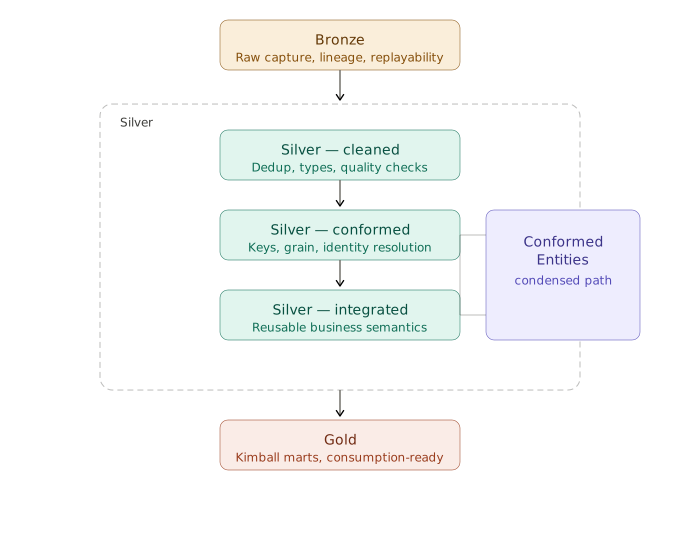
Figure: The Silver progression from cleaned to conformed to integrated. Each stage adds clarity and semantic commitment, reducing ambiguity downstream.
Gold still matters here. Gold is the curated dimensional consumption layer: Kimball-style marts that are ready for analytics use cases. Reporting and semantic tools consume Gold; they do not replace it.
7. Common Anti-Patterns
Unclear Silver contracts create two predictable anti-patterns.
The first: teams copy-paste business logic across multiple Gold marts to ship faster, and small local edits eventually produce multiple versions of the same KPI.
The second is subtler: to avoid that duplication, teams start chaining Gold models to other Gold models. The graph turns sideways, change impact becomes hard to predict, and you end up with Gold-on-Gold dependency spaghetti that is fragile to test and painful to govern.
The Conformed Entities sublayer should materialize shared entities and shared metric logic once: conformed customer entity, order lifecycle states, active user logic, revenue recognition logic, and shared time-grain logic. These artifacts should be shared and versioned for high-frequency decisions, not stretched into a rigid enterprise-wide model for every edge case.
The goal is not complete semantic closure. The goal is to remove repeated ambiguity from recurring business questions. When teams respect this progression, metric consistency improves and change velocity increases without turning Gold into a bottleneck.
This post covers the problem and the design pattern. In part 4B I cover how to operate it: design principles, governance wiring, ownership, and an implementation blueprint you can start on today.
If you want a practical starting move, do not redesign the whole platform. Pick one recurring metric dispute, model it through the semantic boundary once, and make that path governed and reusable. That is the operating problem Part 4B takes on.
References
[1] P. Strengholt, Building Medallion Architectures. Sebastopol, CA, USA: O’Reilly Media, 2025. [Online]. Available: https://www.oreilly.com/library/view/building-medallion-architectures/9781098178826/
Join the Discussion
Thought this was interesting? I'd love to hear your perspective on LinkedIn.